7. Is It Live, or Is It Memorex?
Oct 24, 2026In 1972, a commercial claimed that Memorex recording tape reproduced sound so faithfully that you couldn't distinguish the recording from the live performance.[1]
Is that what the Gospels are? Recording tape? Or are they more than that?

Memorex?
The Gospels aren't fairtales. They most certainly are rooted in historical events—things that actually happened.
But are they written for the purpose of being historical records? Are they attempting to record exact chronology, precise details, and verbatim speech for the sake of human posterity?
This topic is like quicksand. If we approach the topic based on what we feel or on theoretical generalities about "what the Bible is supposed to be"—and it is easy to get caught in this trap— that's when the topic goes off the rails and we get bogged down in the swamp of theoretical vagery.
For example, the inspiration of the Bible comes up here almost immediately for at least some—if not many—Christian readers because they have been taught that it belongs here as the key question. History, then, gets defined through whatever particular model of inspiration they were taught—and the conversation is over before it begins.
Inspiration is an important topic. But the question, here, is far more focused: What kind of history do the Gospels themselves show us they are writing? And there is especially one way to inquire into this: What do these texts actually do when they tell what is purportedly the same historical event? By looking at that closely, we can learn how the writers themselves viewed what they were telling.
An Example
So let's look quite briefly[2] at one example: those texts that are normally called "the divorce texts" in the Gospels.[3] It is especially enlightening to compare the Mark 10 and Matthew 19 texts. They show how the same historical event are handled differently by the two Gospels.
Mark and Matthew do not tell the story in the same way, and they do not simply offer different details. Mark is the simpler, more direct story; Matthew rearranges some of the details to offer a more heightened attack against the Pharisees.
Matthew does not simply repeat Mark with a few added details. Instead, he rearranges the conversation, moves the creation argument earlier, shifts the discussion of Moses later, and even places the crucial words “command” and “permit” into the mouths of different speakers. Matthew accepts Mark’s basic story, but deliberately reshapes it for his own story-telling needs.
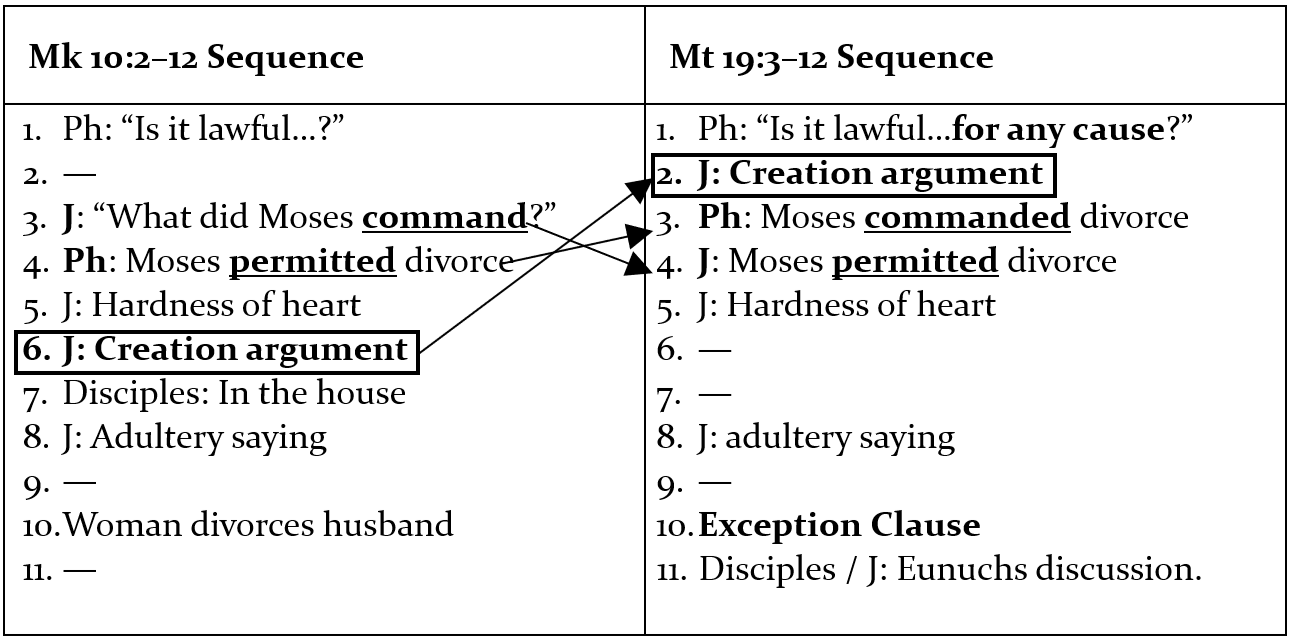
Mark's "in the house" is a typical Mark feature.
What is especially interesting is the way Matthew reshapes Mark’s story with a result that it sharpens the controversy with the Pharisees. Matthew adds the phrase “for any cause,” making their question more specific. He moves Jesus' creation argument up to the front, has the Pharisees say Moses commanded while Jesus corrects them with "Moses only permitted." Matthew adds the exception clause, changing the focus—as well as adding the discussion about eunuchs.
These are not "extra details left out by Mark." These additions fundamentally change the focus and thrust of the story in Matthew's Gospel.
And there's even more—a deeper way in which Matthew has embedded the theme into his fight with the Pharisees. Unlike Mark, Matthew begins his Gospel with Joseph,[4] a law-abiding (δίκαιος, dikaios, "righteous") man, intending to divorce Mary because he found her unfaithful (as a result of her porneia).[5]
Five chapters later in Matthew, in the sermon on the Mount, divorce is brought up against the Pharisees' easy allowance through their own tradition. "Except for porneia," in Matthew, contrasts Joseph's merciful application of the law as a requirement for her porneia, with the Pharisees' strict adherence to their own tradition about it.
Taken together, these changes make Matthew’s version both more pointedly confrontational against the Pharisees and more explicitly concerned with the demands of discipleship.
These texts are often treated as detachable proof-texts about divorce, and they are almost always simply added together—collated, conflated, mashed—to produce a doctrine of divorce. But in actuality, they are not merely “divorce texts”; they are parts of distinct Gospel narratives, placed in different contexts for different purposes.[6] Instead of pressing these into one, each text should be dealt with more diligently.
His Story
In these two Mark and Matthew texts, we can easily accept that they are retelling a single remembered historical event (very likely originally transmitted through oral tradition[7]).
That said, we can just as easily see that they do not exactly match and that they are telling the story differently from each other. (Did Jesus or the Pharisees bring up Moses? Or say "commanded"? Was the creation story brought up at the beginning or the end?)
Whether readers now focus on "contradictions" as dispelling the Bible, or seek to solve the issue by mashing the stories together, it shows that neither group is much interested in dealing directly with the actual details of the two Gospels.
These stories are clearly interpreted tellings of a remembered story. It was not told for its own sake. Rather, the "so what" of the story—as it has been woven into each Gospel—is far more the guiding issue than any technical interest in pure history.
Hence, when we evaluate whether these texts are history, we must conclude that they do not record exact chronology and precise details, nor especially do they deliver verbatim speech.
These are Gospels—theologically shaped retellings of the Jesus story.
It is very important to note that the key choice is not between “history” and “story.” Indeed, the Gospel writers can rightly be understood as more interested in the theological weight of the story than in history for its own sake.
Luke, who chooses not even to tell this particular story (and that is a question all by itself), comes especially close to the historian’s stated aim in Lk 1:1–4. But even Luke is not merely preserving data for posterity. Throughout his Gospel, he selects, arranges and rearranges, emphasizes, and interprets in order to state who Jesus is and what these events mean.
The Main Question
So the main question is, What happens when historically rooted events are told by authors who certainly accept the historical basis of the story, but who are after something more impactful and lasting than bald history?
Much like preachers speaking to different audiences, the Gospels tell the story of Jesus in ways shaped for particular readers and particular purposes.
Are they based in history? Yes, of course they are.
Were they written merely as histories? No. They each were written to interpret the significance of Jesus, to shape how their readers understand him in light of the scriptures and early Christian tradition, and to define what discipleship looks like.
So when the Gospels tell the same event differently, our first response should not be to force the details into a single reconstructed story. Instead, we should ask what each writer has chosen to emphasize, how the story has been shaped, and what that Gospel wants its readers to see. Learning to ask those questions is one way to get more from Bible study.
 https://www.biblicalconversation.com/more
Questions to Consider
- If the Gospels are historically rooted but not trying to function like modern recordings, what kind of history are they actually giving us?
__________________________________________________________________________________________________________________________________________ - What do the differences between Mk 10 and Mt 19 suggest about the freedom Gospel writers had to reshape remembered material?
__________________________________________________________________________________________________________________________________________ - When chronology, wording, or sequence changes from one Gospel to another, should our first instinct be to harmonize the details—or to ask what the change accomplishes?
__________________________________________________________________________________________________________________________________________ - How does reading the Gospels as interpreted tellings of Jesus’ story affect the way we think about both history and theology?
__________________________________________________________________________________________________________________________________________
Next Week:
8. "Why Gospel Origins Matter"
Why should the way the Gospels came into being affect the way we read them?
Series Note
This is Study Session #7 of the free, online, ten-session Bible study series: Beyond the 5th Gospel. It is best to begin with Study Session 1 and follow the entire study in the proper order, on a week-by-week schedule.
Because this is copyrighted material intended for personal or group study, you are granted the right to freely use this material in Bible classes, small groups, private study, or similar settings—as long as you keep the material unchanged and intact, including this series note.
If you have come to this study session out of sequence, please go here for the beginning of the series:
https://www.biblicalconversation.com/blog/5th-gospel-prelude
Go here for all available PDF downloads:
https://www.biblicalconversation.com/studiesbc#section-1788376027032
Thank you.
Gary D. Collier

Footnotes
[1] https://www.youtube.com/watch?v=KeeuT3ciqpI
[2] Since this is only an illustration, I will merely summarize a great many details. For a more, see Gary D. Collier, “Rethinking Jesus on Divorce,” Restoration Quarterly 37, no. 2 (1995): 80–96.
[3] Mk 10:2–12; Mt 5:31–32; Mt 19:3–12; Lk 16:18
[4] Joseph, who is never mentioned in Mark, in Matthew is a foil against Herod, but also against the Pharisees (1:16, 18, 19, 20, 24; 2:13, 19) for the way he intends to obey the law (unlike the Pharisees).
[5] See Deut 22:23–24, where intercourse with a betrothed woman (porneia) is treated as a capital offense, with both parties subject to stoning when the act is understood as consensual. Thus, when Matthew says that Joseph, finding Mary pregnant during their betrothal, intended λάθρᾳ ἀπολῦσαι αὐτήν, lathra apolusai autēn, (“to privately divorce/release her,” Mt 1:19), he portrays Joseph as following the law, but choosing a course markedly less severe than the strict penalty specified in Deuteronomy. (There is no evidence that stoning was ever practiced for this law.)
[6] The Torah does not appear to contain a separate statute governing consensual intercourse between a betrothed man and woman before marriage, although a woman was clearly expected to enter marriage as a virgin (cf. Dt 22:13–21). Dt 22:23–24 concerns a betrothed woman who has intercourse with another man, while Ex 22:16–17 and Dt 22:28–29 address an unbetrothed virgin. There is considerable irony, then, in current-day applications of Matthew's texts. Interpretations of Matthew’s “exception clause” that treat porneia as establishing grounds by which a married Christian may legitimately get out of a marriage read Jesus’ statements the same way the Pharisees were reading Moses’ statements: under what circumstances is divorce permitted? Instead of this, Jesus’ response moves in precisely the opposite direction, away from permissible grounds for divorce and back toward the permanence intended in marriage. The texts in Matthew and Mark (and even Luke) address different situations, and collapsing them into a single rule produces an application the texts themselves do not make or even support. Nor do any of the Gospel texts which are dealing with this subject give instructions for how Christian communities are to respond to people who fail to live up to the ideal expressed here—even though traditionally, that is exactly how these texts have been treated. Other texts must be examined for how sinful and failing people are to be treated.
[7] For oral Jesus tradition specifically, the strongest are: 1Cor 11:23; 15:3–5; 2Th 2:15; Lk 1:1–4. Other NT texts using similar language of receiving, handing on, or holding tradition include: 1Cor 11:2; 2Th 3:6; Gal 1:9, 12; Phil 4:9; Jude 3.